
- At the begining of the Edo period, on the place where today is located the Gotokuji Temple, it was a small temple where a very poor monk lived, accompanied only by his cat, named Tama.
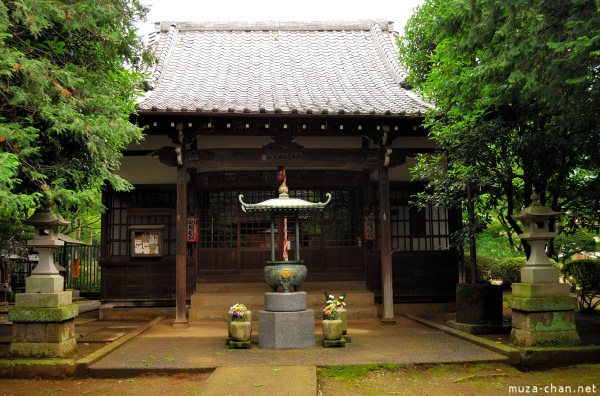
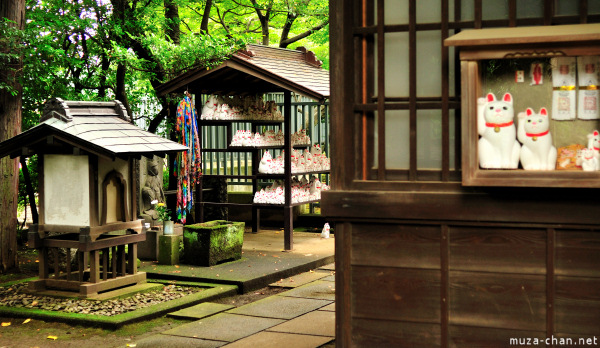
After the cat died, it was buried in the Temple’s cemetery and the Maneki Neko sculptures were made to honor the magical cat. The Temple is located in Setagaya-ku
The legend of Maneki Neko is a reflection of the popularity and importance the cat has played in the history of Japan.
“During the sixth century in Japan the emperor made his cat a noble. In this period there was a strong association with the nobility and the cat, said Dr. Roger Tabor, cat biologist and author of The Rise of the Cat and 100 Ways to Understand Your Cat.”The average person in Japan did not own cats. “The nobles had their cats on leashes in the Heian period,” continued Dr. Tabor. Cats were kept in the nobles’ palaces at this time and not allowed to run free. “In 1603 the Shogun took over in Japan and part of what he did was to take away the symbols of the aristocracy such as the cat. Only aristocrats could have cats before them,” said Dr. Tabor. After this time cats became accessible to the general public.
“At around the same time in 1602, a disaster hit the Japanese economy, which had been built up around the aristocracy who had a huge appetite for silk robes. The silk robes were made by the silk worm which had been hit by an epidemic of rats and so part of an imperial decree was that all the cats had to be set free,” said Dr. Tabor. This was done, so the cats could kill the rats and save the silk worms which were so important to the Japanese economy. Today, cats are extremely popular pets in Japan.
Maneki Neko really represents all our pet cats. As every cat owner knows, their cat beckoned them to take them home and has brought them the good luck and fortune by providing them with love and companionship.
Today, Cats are extremely popular pets not only in Japan, around the world and throughout time. Nothing demonstrates this better than, when the cat becomes part of a country’s culture, history and mythology.
Maneki Neko, the beckoning cat of Japan, which brings good luck and fortune is a perfect example of this.
Often seen in stores and businesses particularly around the front desk or cash register, the Maneki Neko is a very popular lucky charm. This feline figure is said to call in good luck and good fortune.
He typically holds a gold coin or ingot in one hand while beckoning customers into the establishment with the other hand. He has several names: Maneki Neko, The Lucky Cat, The Money Calling Cat, The Beckoning Cat, Money Cat, Fortune Cat.
Legends
Maneki Neko is the subject of a number of legends. Here are three of the most popular, explaining the cat’s origins:
The Temple Cat: This story goes that a wealthy feudal lord was taking shelter under a tree near Gotoku-ji temple (in Western Tokyo) during a thunderstorm. The lord saw the temple priest’s cat beckoning to him and followed; a moment later the tree was struck by lightning. The wealthy man became friends with the poor priest and the temple became prosperous. When the cat died, supposedly the first Maneki Neko was made in his honor.
The Courtesan: A courtesan named Usugumo, living in Yoshiwara, in eastern Tokyo, kept a cat, much beloved by her. One night, the cat began tugging at her kimono. No matter what she did, the cat persisted. The owner of the brothel saw this, and believing the cat bewitched, cut its head off. The cat’s head then flew to the ceiling where it killed a snake, ready at any moment to strike. Usugumo was devastated by the death of her companion. To cheer her up, one of her customers made her a wooden likeness of her cat as a gift. This cat image then became popular as the Maneki Neko.
The Old Woman: An old woman living in Imado (eastern Tokyo) was forced to sell her cat due to extreme poverty. Soon afterwards the cat appeared to her in a dream. The cat told her to make its image in clay. She did as instructed, and soon afterward sold the statue. She then made more, and people bought them as well. They were so popular she soon became prosperous and wealthy.

